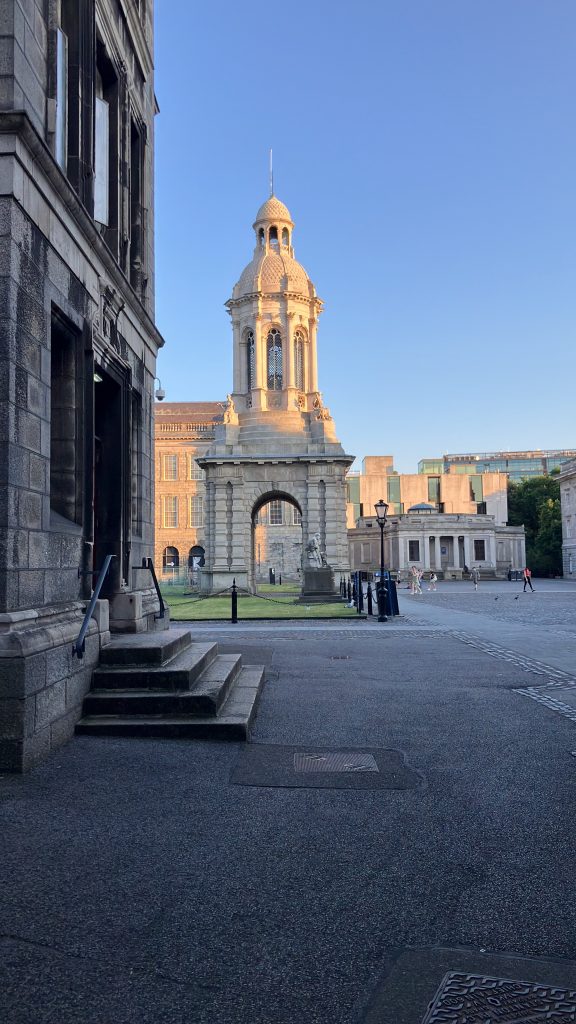
I could be forgiven for believing that Dublin is always warm and sunny. Given also that I only went to Trinity College Dublin during my three-day On Traduit à Dublin visit, I came away with the equally reasonable conclusion that everywhere in Ireland must be as stunning as the Trinity campus.
What an experience I had!
I was told by practically everyone that the heatwave in July was not at all normal for Dublin. The city-centre campus took my breath away with its beauty. Walking around Trinity, I could almost sense the presence of some of its famous names — Oscar Wilde, Jonathan Swift, Samuel Beckett and Bram Stoker, to name but a few.
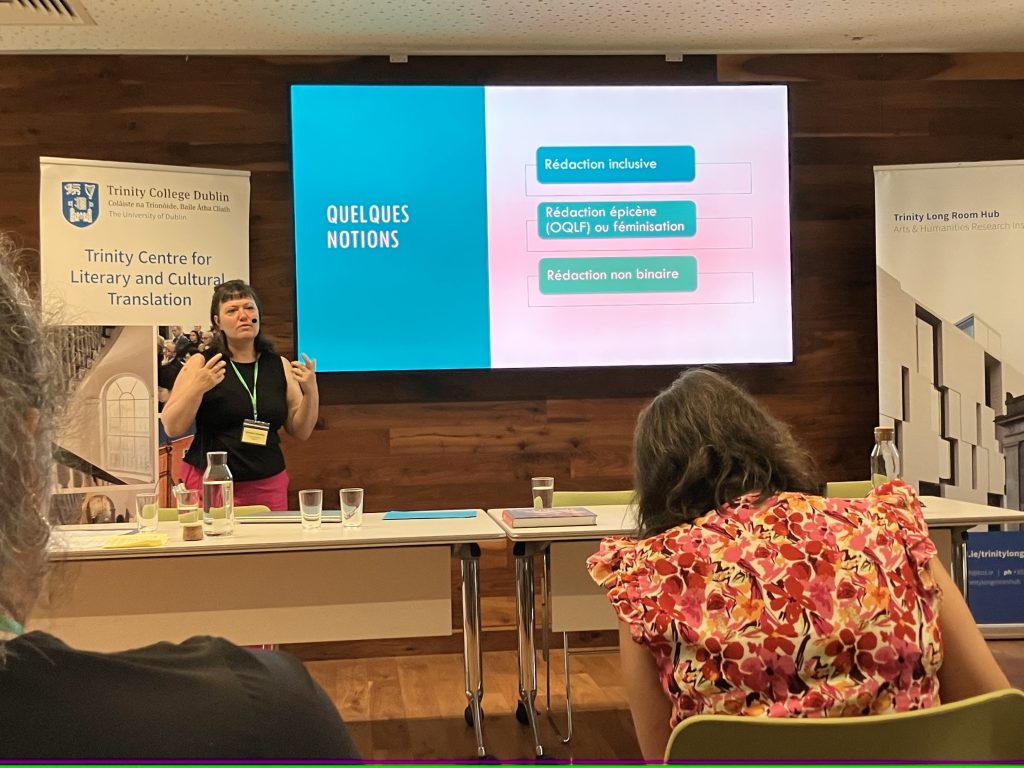
But I had not gone to Dublin to admire the architecture. On Traduit à Dublin was a three-day professional training event for working translators in the English–French and French–English language pair, organised by the Trinity Centre for Literary and Cultural Translation in collaboration with the Association of Translators and Interpreters Ireland and Magistrad Canada. Eleven trainers from six countries led a programme of practical workshops, translation slams, sessions on translation and language problems, and a translation competition. Just as importantly, the event brought together practising translators from different countries and professional backgrounds to exchange ideas and experience.
I suspect all attendees will say the same: the level of expertise in the room — not just from the presenters, but from all the attendees — was truly beyond comparison. I felt I learned so much. Everything came thick and fast, and it is difficult to remember every single point made, every idea absorbed. But this is why I made copious notes for myself and my own recall, and why it is also invaluable that the presenters have shared their presentations. Wonderful.
One outstanding presentation that particularly stayed with me was Grant Hamilton’s exploration of the French adjective performant, a deceptively simple word that can so easily lead translators into the trap of the “obvious” English equivalent, powerful. His point was that this is often precisely where translation becomes weak: performant does not mean the same thing in every context. A product might be high-performance, a company top-performing, a researcher top-flight, a student high-achieving or a system efficient. Sometimes the best solution is not an adjective at all, but a verb. It was a wonderfully practical reminder that good translation is not about finding the word that looks right; it is about working out what the source text actually means and then finding the English that says it properly. Essentially, when translating we are creating a new communicative device (per Christiane Nord) and ought to remember that.
I cannot speak highly enough of the Dublin experience, from my own personal point of view. I feel humbled in the presence of such greats and yet, at the same time, increasingly feel “one with them”.
As such, events like On Traduit à … are invaluable. They do not simply help us develop our skills as translators. They encourage curiosity and excellence in writing, expose us to new ideas and approaches, and, perhaps most importantly, compel us to reflect on what we can do better.
That, for me, is the real gift of On Traduit à …
And now, Quebec in 2028!
Pictures by V. Cubilié-Ratio